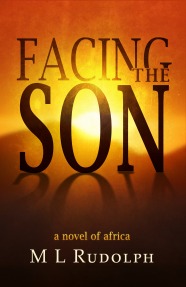
About Facing the Son, a novel of Africa

1: Where did the idea come from for the book?

I wanted to go back in time to West Africa, when I traveled there in the early eighties.  It was a different place than today in that the risk to white foreigners, western, or European travelers, was not so pronounced.  The US State Department didn’t warn us to stay close to the main cities, and never travel alone.  Such as it was, I was able to get around without the sense that my mere presence would incite trouble.

Plus I wanted to tell a story about a father trying to find and repair his relationship with his son, a subject very close to my heart.

So I set the story in a place and time that was familiar to me, and struggled with the father’s journey not only though the countryside but through his own feelings and past behavior.

2: What genre does your book come under?

Let’s say Adventure, or possibly Family Adventure, or Crime.

3: Which actors would you choose to play your characters in a movie rendition?

I could see Jeff Daniels as Matt, the midwestern father in search of his son.  Maybe Chris Rock as Jean-Louis, the angry concierge.  Mary Steenburgen as Melanie, Matt’s ex-wife, organizing the trip to force the two men in her life to come back together.

4: What is the one-sentence synopsis of your book?

Matt Reiser fulfills his ex-wife’s request to travel to west Africa in search of their estranged son, and upon arrival he is drugged, robbed, and left penniless and paperless in an Abidjan slum.

So starts the book and Matt’s journey of discovery.

5: Is your book self-published, published by an independent publisher, or represented by an agency?

My book is self-published.  And I plan on self-publishing all my books, even if I get lucky and one turns out to be an exceptional hit.  I like the independence.  And I will remain a GREAT fan of all independents.

6: How long did it take you to write the first draft of your manuscript?

The first draft took about eight weeks.  Revision can take me many months more, depending on how much time I have to devote to remake and rework the story, the characters, and the language throughout.  And I reworked this story at least a dozen times over the course of eighteen months.

7: Who or what inspired you to write this book?

I just wanted to write the kind of book I like to read.  Plus I really missed my son, and writing about those feelings a father has for his son, I felt a little bit closer to him, even though not physically closer.

8: What else about your book might pique the reader’s interest?

Take a look at the headlines coming out of north Africa.  My characters are amalgams of some of the people I met and got to know over the course of my travels through the territory.  There was always a tremendously strong and prevalent feeling about the former French colonists, and this I noticed and felt constantly.  There was and still is a seething animosity toward that chapter of history.  It’s not surprising to see that historical and cultural resentment flare up as it has recently.

If you’re interested in looking a little bit deeper into the territory through the eyes of fictional characters, then this is the book for you.

Now!  Let’s get to know this great new novelist:

Tom Gething


Interview with a semicolon

Reblogged from Tom Gething re: reading:

Click to visit the original post

Gething:  Thank you for agreeing to this interview.

Semicolon:  The pleasure's all mine; thank you for having me.

Gething:  My interest is in the controversy you have stirred in the literary world.

Semicolon:  I've done no such thing; those who don’t use me seem to be causing all the fuss.

Gething:  That’s my point. Many modern writers, in particular Cormac McCarthy in his interview with Oprah…

Read more… 527 more words

Continue reading

Guest Post: The lowdown on Pasadena, by Tom Gething

Undocumented workers, barrio punks with guns, high-tech strip clubs, grubby city politics, and a backpack full of dirty money—all play a part in the smart new crime novel, Pasadena Payback, by my friend and fellow indie author, M.L. Rudolph.  The action mostly takes place in Pasadena, best known for its Rose Bowl and festive parades, but it starts with a gripping scene on the Arizona border and inevitably leads back there for its life-or-death finale. Serious stuff, but it’s getting there that makes this a fun, fast-paced book.

Crispín, an undocumented landscaper, is at the center of the storm. Everyone is looking for him, or maybe it’s what he knows or what he’s carrying that they want. Poor Crispín has certain obligations he never asked for and family on both sides of the border. He’s just trying to keep a low profile like all those men who stand in front of the Home Depot looking for day jobs. But things go quickly awry.

Rudolph has lots of fun exposing the flaws of the people looking for Crispín, and for me it was this social satire that made the book so enjoyable. Everyone wants power—control really—over others. The ones with power are looking to keep it; the ones with money are looking to buy it; the ones without money are looking to steal it. Power, it turns out, is illusory and quickly vanishes because there’s always a price, or a payback, for getting it.

I enjoyed the West African setting of Rudolph’s first novel, Facing the Son, but this one is even better. It’s gritty, contemporary and right in our own backyard, with characters and issues that are all too real.

Pasadena Payback


The Secret History of the World: As Laid Down by the Secret Societies, by Mark Booth

2008. A stroll through history with an eye on the cryptic and hidden knowledge shared down the ages among initiates to secret societies.

I enjoyed the read but I’m not sure where I ended up at the end of the stroll.

Okay, knowledge is powerful and throughout most of history was carefully controlled – maybe still now? – and disagreeing with the men in power could cost you your life.

So there is/was samizdat circulated among the cognoscenti. There is more to heaven and earth than is dreamed of in our philisophies, Horatio. I’ll buy that.

History extends further back than we know. Our knowledge is incomplete. Intelligent resourceful humans existed prior to the invention of writing as a means to record and convey their knowledge. Man will strive to survive above all else and if that means keeping certain knowledge from those who will use it to kill you, then of course smart people will do that.

This study is an impressive and erudite work. Booth has pulled together many works and signs that support the existence of secret knowledge and secret societies throughout history. Why doesn’t it excite me that much? I’m impressed by his work, just not that excited by his conclusions.


Under a False Flag, by Tom Gething

2012. A gripping story of a rookie spy who played the role but never bought in with his soul.

Caught in the turmoil of the 1972 Chilean revolution, young and earnest Will Porter learns his trade by living and working undercover. He inserts himself into the community, makes friends, and even falls for a local girl. But his life is a lie, and to perform to his boss’s satisfaction, and to the ever-shifting commands from a Washington DC in Nixonian political turmoil, Will struggles to reconcile the demands of his job and his country with his needs as a young man in search of friendship and love.

Tom Gething has written an engaging story about the sorts of struggles all of us experience, albeit in far less stressful situations, as we balance our work with our family and personal lives.

Gething has obviously read widely from the newly declassified documents from this sordid chapter in American diplomacy. He balances fact and fiction to examine the human cost of patriotism, of career ambition, and of soulful integrity.

Under a False Flag


(Day Before) Fathers Day FREEBIE!

   June 16, FREE DAY,  for my new novel Pasadena Payback.

   Get Dad a gripping good read for that new Kindle. Take it to the beach. Take it to the shade. Take it with you on your next plane ride.

Crispín Gomez Diaz runs cash between Pasadena and Nogales to pay off his missing brother’s old debt. He has family in Los Angeles and in Sinaloa, and he does what he’s told to keep his family safe from retribution.

  Dirty debts, raw ambition, and old loyalties collide in this fast-moving tale of honor and payback.


The Exegesis of Philip K. Dick, by Philip K. Dick

2011. When time stops, “the substrate is revealed.” So begins this edition of PKD’s end-of-life compulsion to understand the revelation he experienced in February 1974 then again in March. He may have seen through to the underlying reality of, well, our perception of reality. Or he may have had a small stroke. Or he may have had an acid flashback. Or he may have been visited by a superior intelligence.

PKD explores every possible angle for his sudden insight by writing mostly by hand nearly every night for the remaining eight and a half years of his life. He analyzed himself and his own work especially ten novels he felt to be form a meta novel. He continued to produce novels and was working on still another when he died. He had reached a point in his career where money began to flow a bit more freely, a fan base had begun, international markets were bestowing more praise than his home country, and SF conventions were inviting him to keynote and paying for his trips. His overriding ambition throughout everything was to understand the above revelation. He wrote; he debated with himself; he called his friends in the middle of the night with further insights; he figured it all out only to dismiss his findings in the cold harsh light of the next morning when he’d start the process all over again.

It’s not clear to me if PKD ever meant for any of this work to be published, but I’d guess from my layman’s distance that he probably did. He wrote mostly by hand and didn’t bother to keep the material in an orderly fashion, but he had enough faith in his reputation to expect future biographers to come in after his death and sort through the mess he left behind. Friends even spotted him carting stacks of handwritten material to the incinerator at times, meaning he did dispose of something, which meant he did allow the rest of his pages to survive.

I spent months reading The Exegesis. The material was too dense for me to read more than ten to twenty pages at a time. This edition runs to 900 pages. I didn’t want to race through it. I wanted to think about it. Let the ideas linger, maybe fester, maybe germinate. And unusual for me, I expect to return to the book from time to time just to jump in for a blast of PKDickiana. I like how he challenges everything, every idea and solution he conjures, how he takes the BUT WHAT IF opposite side of every auto-debate.

It’s his process of exploration that I find most intriguing. How he hammers unrelentingly at a problem to see just how malleable are the assumptions upon which we base our worldview.

If you like PKD, and if you like digging into a writer’s journals for insight into how and why he wrote what he did, you’ll like Exegesis. If you aren’t familiar with PKD, this is still a violently good read. And if you stick with it, you’ll end up reading his novels which is exactly what you should do after you finally make his intimate acquaintance.


Follow

Get every new post delivered to your Inbox.

Join 5,105 other followers